The Long Silence After the Last Name: Six Borders War Memorials on a Slow November Trail
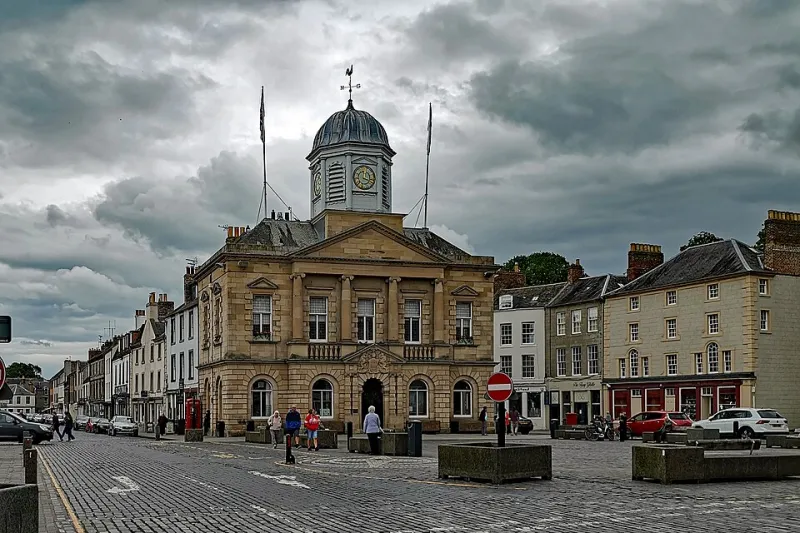
Photo: PaulT (Gunther Tschuch), CC BY-SA 4.0, via Wikimedia Commons
November does something useful to a war memorial. The leaves are off the trees, the light is low and honest, and the stone stops competing with the shopfronts. In the Borders, these memorials are rarely set apart in a field. They sit at the edge of a market square, beside a kirk, at the top of a wide street or on a small green where the bus turns round. You can pass one on the way to buy bread and miss it entirely.
This trail links six of them: Galashiels, Melrose, Selkirk, Hawick, Jedburgh and Kelso. It is a walk in the practical sense rather than the heroic one. You will walk short stretches in each town, read the stones, and then use a bus, train or car for the bigger gaps. The whole thing makes a long, full day by car, a gentler two-day outing by public transport, and a very good reason to be outdoors without pretending the outdoors is only about hills.
The shape of the route
Start at Galashiels, which is the easiest arrival point. The Borders Railway runs from Edinburgh Waverley down to Tweedbank, with Galashiels station putting you within a short walk of the town centre. From there, local Borders Buses services connect Galashiels with Melrose, Selkirk, Hawick, Jedburgh and Kelso. Timetables are not what they were, and Sunday services are especially thin, so check Traveline Scotland and the operator's own site before you commit. If you are driving, the obvious loop uses the A7, A68 and A698 corridors, but park once in each town and walk from there. Do not try to walk between the towns on the main roads. The verges are not designed for it and the memorials are not going anywhere.
A sensible public transport version splits the trail in two. Day one: Galashiels, Melrose and Selkirk. Day two: Hawick, Jedburgh and Kelso. That leaves room for soup, a browse in an independent shop and the kind of unhurried reading these stones deserve. If you are doing it in one go by car, keep each stop short. Six memorials in one afternoon is plenty. More than that and the names start to blur, which is the opposite of the point.
How to read a memorial without turning it into a quiz
You do not need a family connection to read these stones well. Start with the dates. Most civic memorials in the Borders carry the First World War, often with a later panel for 1939–45 and, in some places, post-1945 losses. Look at the regiments. The King's Own Scottish Borderers appears again and again, along with the Royal Scots, the Cameronians, the Black Watch and various artillery and service corps. Then look at the names. Borders surnames repeat across the stones: Scott, Elliot, Turnbull, Douglas, Armstrong, Crosbie, Hogg. Sometimes the same family name appears three or four times in one column. Sometimes a name appears on the town memorial and again on a church board inside. That duplication is not an error. It is a reminder that people belonged to more than one place.
Look for ages where they are given, and for ranks that seem out of step with the rest. Look at the condition of the lettering. Some memorials have been cleaned and re-lettered; others have been allowed to weather into a softer grey. Neither is disrespectful. Stone does what stone does.
The six stops
Galashiels
The memorial here feels like part of the town's working geography: close to the shops, the mills and the everyday traffic. Galashiels lost a great many young men from the textile trade, and the names reflect streets and families that still sound local. Read the regiment columns slowly. The mix of local battalion and wider service is a useful introduction to how Borders towns contributed.
Melrose
Melrose is the gentlest stop on the trail. The memorial is a short walk from the abbey and the town centre, and the scale is intimate. This is a good place to notice how a small town remembers: not just the names, but the way the memorial sits among houses, gardens and the ordinary comings and goings of a place that has to keep living.
Selkirk
Selkirk wears its history openly, and the memorial fits that habit. The town's Common Riding memory and its military memory sit close together. Look for the KOSB connection and for the way the names are arranged. In a town this size, the list is long enough to be a shock and short enough to read in full. Do that if you can.
Hawick
Hawick's memorial has a civic weight to it. This is a bigger town with a bigger roll call, and the stone carries the confidence of a place that expected to be remembered. The textile and engineering trades are part of the story, as are the local regiments. Take your time here. It is easy to skim a large memorial; it is better to read one column properly and then stop.
Jedburgh
Jedburgh gives you the long view. Reiver history, abbey ruins and the memorial all sit within a few minutes of each other, and the contrast is sharp. The names on the stone belong to a border town that has been defended, raided and rebuilt for centuries. The memorial is not the oldest story in Jedburgh, but it is part of the same habit of marking what has been lost.
Kelso
Kelso is a good place to finish. The town square, the abbey and the river give you somewhere to walk afterwards without needing a plan. The memorial itself is a quiet civic statement, and the names repay the same slow reading as the others. By this point you may notice something: the stones are different, but the rhythm is the same. Date, regiment, name, age, name, name.
Reading with care
These are memorials, not heritage puzzles. Do not climb on ledges, sit on wreaths or trace lettering with chalk or paper. Avoid flash photography, especially inside kirks, and keep your voice low if a service is happening or a family is visiting. Poppies are welcome, but secure them so they do not blow into the road. If you visit on 11 November or Remembrance Sunday, expect services and give them room. A midweek afternoon in November is usually quieter, and the low sun does interesting things to granite.
Practical notes for a reflective day
Wear shoes you can walk in on pavements and wet grass. Carry a small torch for darker church porches. A notebook is useful, but do not feel you have to record every name. One name, one regiment, one date is enough to take home. If you are using buses, build in slack. The Borders rewards patience and punishes tight connections. If you are driving, do not park on verges or in front of memorial gardens. And leave time for a cup of tea at the end, because a reflective walk should not end with a sprint for a bus.
The trail is best treated as an evergreen heritage outing rather than a one-week event. November gives it atmosphere, but the names are there in June too. The point is not to have a solemn day out. The point is to stand in six ordinary Borders towns, read what they chose to carve, and then go and look at the streets those names came from.