Sixty Minutes, Four Landmarks: A Field Guide to Reading a Borders Village
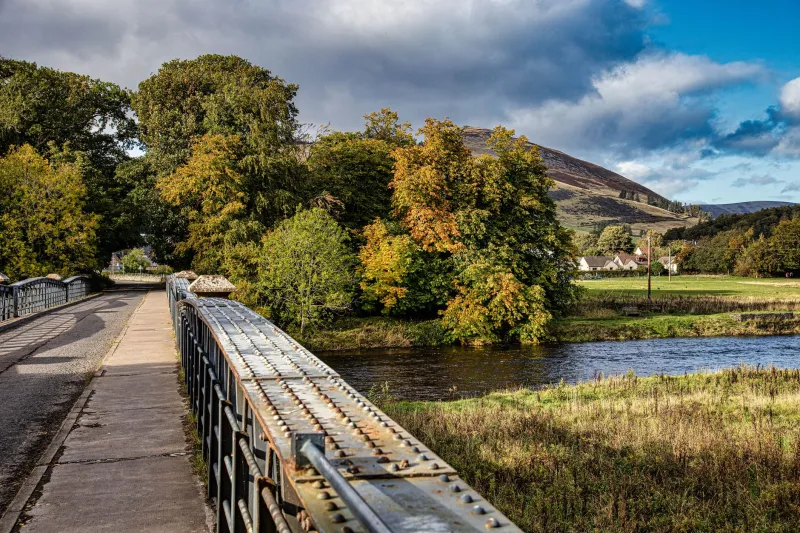
Borders villages can look shy at first. A few houses, a green, a road that seems to pass through rather than stop. But almost every one of them carries the same four pieces of evidence: a kirk, a cross, a bridge and a war memorial. Learn to read those in the right order and an hour is enough to get the gist of a place — not the full story, but a useful, honest sketch of how it grew, what it traded, where its roads went and who it lost.
This is a field guide, not an exam. Pick a village you have not really looked at before, park considerately, and give yourself sixty minutes. The method works at Bowden or Ancrum, Morebattle or Eckford, and most places in between.
First ten minutes: get the lie of the land
Before you read anything close up, stand back. Where is the kirk in relation to the houses? Is the cross in the widest part of the street or tucked away? Does the bridge sit below the village or at its edge? Is the memorial on a corner, in a garden, or on a green?
That layout is the first sentence of the village’s story. A kirk on a raised bank often points to an older religious site, sometimes pre-Reformation. A wide street with a cross in the middle suggests a market town that once mattered more than its size now implies. A bridge below the village usually means the old road came down to the water, not around it. A memorial at a junction tells you where the community thought people would pause.
The kirk: the oldest building in the story
Give the kirk fifteen minutes. You are not looking for architectural perfection. Look for the things that survive: a blocked doorway, a heavy lintel, a bellcote, a graveyard wall that curves rather than runs straight. Curving walls often hint at an older enclosure. Headstones tell you about surnames, trades and ages, and sometimes about people who died far from home.
At Bowden, the kirk’s position above the village and the older stones in the kirkyard do more work than any noticeboard. At Eckford, the kirk sits close to the river and the old road in a way that makes sense of the village’s shape. You do not need to know the dates to read the pattern: worship came first, and the houses gathered later.
Check whether the door is open. Many Borders kirks are locked outside service times, and that is fine. Read the outside, walk the kirkyard respectfully, and leave the interior for another day.
The cross: where the market used to be
Ten minutes at the cross. If a village has a mercat cross, it usually means someone once had the right to hold a market. That right was a licence to trade, argue, announce and punish. The cross was the village’s public square before public squares were designed.
Look at the base, the shaft and the steps. Steps were not decorative: they gave height and made the cross a stage. Some crosses have been moved, repaired or replaced, and that is part of the story too. A cross standing in a wide street at Ancrum or a surviving shaft in a smaller village green tells you where people gathered to buy, sell and hear news.
If there is no cross, do not force it. Some villages never had one; others lost it. The width of the street is still a clue.
The bridge: the old bottleneck
Fifteen minutes at the bridge. Bridges are the most underrated historic buildings in the Borders. They were expensive, political and practical. Look at the number of arches, the cutwaters between them, the width of the deck and any flood marks or repair dates.
A narrow old bridge with a newer road beside it tells you the route changed. A bridge with a sharp bend at one end tells you it was built for carts, not cars. At Ancrum, the old bridge over the Ale Water makes the village’s relationship with the road suddenly clear: the settlement sat where the crossing was, and the crossing shaped the traffic.
Stand at one end and imagine a cart, a horse or a herd of cattle. That is the scale the bridge was built for.
The memorial: the village’s roll call
Last fifteen minutes at the war memorial. This is the part that brings the hour home. Read the names, not just the dates. Look for repeated surnames: brothers, cousins, families who lost more than one. Note the ages if they are given. A village memorial is a roll call of people who were known here, and it is usually kept immaculately.
At Morebattle, as in many smaller Borders villages, the memorial is modest but precise. The names do not need a grand setting to land. They are the reason the hour matters: after the kirk, the cross and the bridge, the memorial tells you what the community was prepared to lose.
Do not treat the memorial as a bench or a picnic spot. Read it, take a photograph if you wish, and move on.
The one-hour method, anywhere
- 0–10 minutes: orientation. Walk the main street and note where the four landmarks sit.
- 10–25 minutes: kirk and kirkyard. Look for old stones, boundaries and changes in level.
- 25–35 minutes: cross or market place. Read the width of the street and the surviving base.
- 35–50 minutes: bridge. Check arches, cutwaters, width and flood evidence.
- 50–60 minutes: war memorial. Read names, surnames and ages.
Respectful exploring
Park where you are not blocking a farm gate or a narrow road. Keep dogs on leads in kirkyards and graze no closer than the stones allow. Do not lift fragments, leave flowers only if they are compostable, and shut gates. If a kirk is open, remember it is a working building, not a museum.
The Borders does not need another rushed heritage trail. It needs visitors who can stand still for an hour and let four ordinary landmarks do the talking.