Rags, Coins and Quiet Requests: Six Borders Wells Worth a Walk
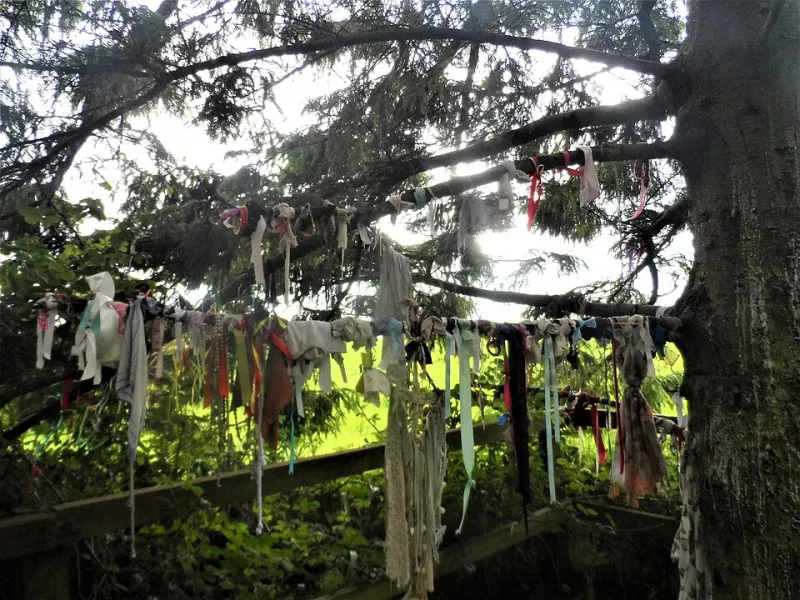
Photo: Sheila1988, CC BY-SA 4.0, via Wikimedia Commons
The Borders are full of wells. Hundreds of them, on old maps and in parish records: wells for saints, wells for cattle, wells that cured toothache, wells you walked round three times while keeping your mouth shut. Most are now a wet patch in a field. A handful survive as something you can stand beside, and those are worth an afternoon.
What follows is folklore first and history second, which is the right order for these places. Names shift from map to map and from generation to generation; a well called St Mary's on one sheet may be the Lady's Well in living memory. Treat the list as a set of starting points, not a survey.
First, the Etiquette
Before anything else. Several of these wells sit on private ground, and access is by the goodwill of the nearest farm or estate. Ask first, close gates, and take your litter home.
Clootie wells are the ones hung with strips of cloth. The tradition is to dip a rag, wish, and leave it to rot — as the rag decays, so the wish works. It is a lovely idea and, at popular sites, an environmental problem: hundreds of synthetic fabrics and non-biodegradable ribbon tied to the same few branches will eventually harm the tree. If you want to take part, use untreated cotton or wool, tie loosely, and take nothing else with you. Don't leave plastic, don't leave messages in plastic sleeves, and don't leave coins in the water — they leach.
St Helen's Well, near Cockburnspath
In the wooded denes behind the Berwickshire coast, where the burns cut down to the sea. St Helen — mother of Constantine, and a patron of wells across Britain — has given her name to springs in a surprising number of quiet corners.
Pair this one with a walk down through the wooded denes towards the coast, which is steep, muddy and excellent in autumn. It is a modest site: low, damp, easily missed in summer growth. The point is the walk and the setting rather than architecture.
St Cuthbert's Well, Old Melrose
Cuthbert's connections run right through the Borders, and the loop of the Tweed at Old Melrose — where the original monastery stood before Lindisfarne — is the heart of them. A well here is a natural focus for the stories: water that was blessed, water that healed, water you came to with a specific and slightly desperate request.
The walk is gentle: down through the woods to the river, along the loop, back up. Combine it with the Trimontium and Eildon paths if you want a full day. Late afternoon light through the trees here is worth planning around.
The Holy Well below Smailholm Crag
Smailholm Tower, the great square keep on its crag, is the draw; the well beneath it is the excuse to slow down. Walter Scott spent childhood summers at nearby Sandyknowe and the landscape lodged in him permanently, and it is easy to see why — the tower, the farmland, the little folded valley.
The walk up to the tower from the car park is short and steep; the well sits in the wetter ground below. Look, don't dig, and don't attempt to 'restore' anything you find loose.
St Mary's Well, Yarrow
St Mary's Loch takes its name from the old kirk and its well, and the whole valley is thick with story — Tibbie Shiels, the Yarrow's ballads, the drowned valley under the water. The well is a small, humble thing in a landscape that does not do humble quietly.
Walk the lochside path, look at the water, then find the well. In winter, with mist sitting on the surface and no one about, it is as good a quarter of an hour as the Borders offer.
The Rhymer's Well, Earlston
Thomas of Erceldoune — Thomas the Rhymer — is the Borders' own prophet, carried off by the Queen of Elfland and returned with a tongue that could not lie. Earlston is his village, and it still holds the fragment of Rhymer's Tower.
A well bearing his name is the sort of place where the story does more of the work than the stonework. Read a verse of the ballads on your phone, then put the phone away.
The old well at Stobo
Stobo Kirk is one of the oldest Christian sites in the region, in a bend of the Tweed with a quiet the main road doesn't reach. A spring in the kirkyard's shadow is recorded on old maps, and the tradition of wells at early church sites is near-universal in Scotland: the water came first, the saint came second, and the building came third.
The walk can be a short one round the kirk and down to the river; extend it along the Tweed if the weather is being kind.
Why These Places Still Matter
A holy well is a place where people have done the same small thing for a very long time — knelt, dipped, wished. That continuity survives the loss of the belief that framed it, and it survives being partly forgotten. You don't have to believe anything to recognise that a rag on a branch in a Berwickshire wood is a message from someone with a worry and a hope, posted in the oldest way available.
Before You Set Out
Check the Historic Environment Scotland record and the local historic environment record for grid references and access notes. Many wells are on private land; if there's a farm, ask. Wear boots, expect bog, and carry a map rather than relying on a single pin dropped by somebody else. Park where you're not in the way of a tractor.
And leave the well as you found it — or marginally tidier. Take a photograph, take a moment, take your rubbish. That's the whole etiquette, really.